Solid Mechanics
“For every machine and structure, whether artificial or natural, there is set a necessary limit beyond which neither art nor nature can pass.”
— Galileo Galilei, Two New Sciences, 1638, translated by Henry Crew and Alfonso de Salvio, 1914
The preceding parts of this book treat forces, moments and motion as if bodies were perfectly rigid. In reality every structural member deforms under load: beams bend, rods stretch, and shafts twist. Solid mechanics, also called mechanics of materials, studies the relationship between the forces applied to a body and the internal stresses and strains that result. The central insight is that force alone does not determine whether a structure fails; what matters is force per unit area, the stress, and how it compares to the material’s capacity to resist it. Figure 8.1 shows the basic ways a bar can be loaded.
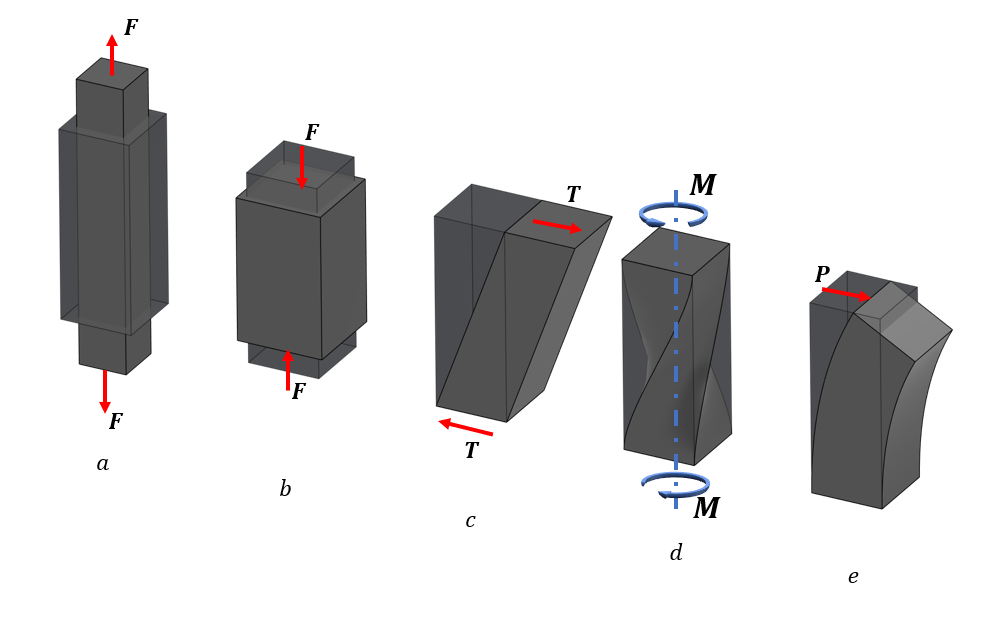
We begin in one dimension, where a single cut through a loaded bar exposes a single number. Normal stress, shear stress and strain are introduced there, followed by the tensile test that supplies the material constants without which no calculation can be closed. That sequence establishes the vocabulary and the habit of working from a cut and a free body diagram to a stress.
The one-dimensional picture then breaks down, and deliberately so. A cut taken at a different angle through the same loaded bar exposes a different stress, which forces us to replace the scalar by the stress tensor and the elongation by the strain tensor. Together with equilibrium of an infinitesimal element and the generalized Hooke’s law, these give a complete continuum model of a linearly elastic solid, valid for any geometry and any load.
The remaining chapters are that model specialised. Beam theory is what the continuum equations become once we assume that cross sections stay plane during bending, and the assumption reduces a system of partial differential equations to a single ordinary differential equation that we solve symbolically. The direct stiffness method for truss analysis performs the same reduction for pin-jointed structures, assembling element stiffness matrices into a global system solved with linear algebra in Python. Both replace the ad-hoc equilibrium equations of classical analysis with procedures that scale to structures of any size, and both are steps toward the finite element method that dominates modern structural design. The part closes where those specialised models fail: at holes, notches and shoulders, where the stress concentrates and only the continuum model, or a chart computed from it, gives the peak.