10.7 Gridfinity
Gridfinity is an open storage system for printed bins, published by Zack Freedman in 2022 [1]. A baseplate carries a grid of \(42 \times 42\) mm sockets, and every bin stands on feet that drop into them, so bins of any size in whole cells fit any plate. Heights come in units of \(7\) mm. The system has no formal standard; the dimensions in common use are those of the open-source generator gridfinity-rebuilt-openscad [2], and the configurator below follows them.
The design is a compact lesson in designing for the printer. One profile does three jobs: the foot of a bin, the socket of the baseplate and the stacking lip on top of a bin are sections of the same rounded rectangle, each a \(45°\) chamfer, a vertical band and another \(45°\) chamfer. The foot is \(0.8\), \(1.8\) and \(2.15\) mm tall from the bottom up and ends in an outline of \(41.5\) mm with a corner radius of \(3.75\) mm. The socket has the same shape, \(0.7\), \(1.8\) and \(2.15\) mm, ending in the full \(42\) mm cell. The difference of \(0.5\) mm on the width is the clearance that absorbs the printer’s tolerance, and the chamfers centre the bin as it goes in, so the fit needs no precision from either part. Every slope is \(45°\) and every surface that faces down is either a chamfer or a bridge, so a bin and a plate print without support. Where a screw hole has to start above a magnet pocket, two layers of \(0.2\) mm turn the round hole into a slot and then a square, which the printer can bridge.
The configurator
The configurator makes bins and baseplates of 1 to 8 cells each way, enough for the bed of a Prusa XL. We pick the printer, a Prusa XL, Core One, MK4 or MINI, a Bambu Lab H2C, A1 or A1 mini, or a custom bed size, and the page refuses a part that does not fit its build volume, even turned \(90°\): a bin of \(n\) cells is \(42n - 0.5\) mm long and a plate \(42n\) mm, so a MINI or an A1 mini takes 4 cells and an MK4 or a Core One 5 by 5. A bin takes a height of 2 to 15 units, a wall of \(0.8\) to \(2.0\) mm, up to \(8 \times 8\) equal compartments, a stacking lip, a scoop at the front of each compartment, a \(45°\) label tab along the back, and pockets for \(6 \times 2\) mm magnets or holes for M3 screws in the feet. A light baseplate is the \(5\) mm grid alone; a full one has \(6.4\) mm more underneath, with magnet pockets in the socket floors and screw holes below them.
The view is drawn in the browser. The 3MF, STL and STEP files are built on the book’s server, which checks each part before it serves it: one solid, the outer size, and a section through the feet or the sockets with the right number of regions, the right areas and the right holes. The STEP file holds the exact geometry, planes, cylinders and cones, for further work in CAD.
Open the configurator in a new tab
Two choices differ from other generators. The stacking lip ends in a flat land \(0.6\) mm wide instead of a rounded knife edge, as in the Fusion add-in GridfinityGenerator [3], and the compartments meet the floor in a sharp edge except where the scoop rounds it. Before a large order of bins it pays to print one \(1 \times 1\) bin and a \(2 \times 2\) plate in the material we intend to use and check that the bin drops in and lifts out freely.
A glass-front bin
A bin with a glass front shows what it holds without a label. Freedman’s window bin replaces one wall of a divider bin with a microscope slide [4]: slides are cheap, come cut to size with ground edges, and resist the scratches that cloud acrylic. Ours takes a standard \(76.2 \times 25.4 \times 1.2\) mm slide in a bin of \(2 \times 1\) cells and at least 6 units (Figure 10.7.1). The slide is sandwiched between the box and a separate front panel: the panel is a frame \(1.2\) mm thick that overlaps the slide by \(3\) mm at the ends and \(1.2\) mm along the top and bottom, with the band over the window behind it. In the box, the rounded inner corners back the ends of the slide and the dividers run square into the glass and support it along its height. The pocket between the two parts is \(0.2\) mm longer and higher and \(0.3\) mm thicker than the glass, and the panel stands \(0.05\) mm clear of the box wherever they meet, a gap for the CA glue that holds the assembly together. Above the slide the dividers slope back at \(45°\), which leaves room behind the band for a finger in every compartment, and the scoop moves to the back wall.
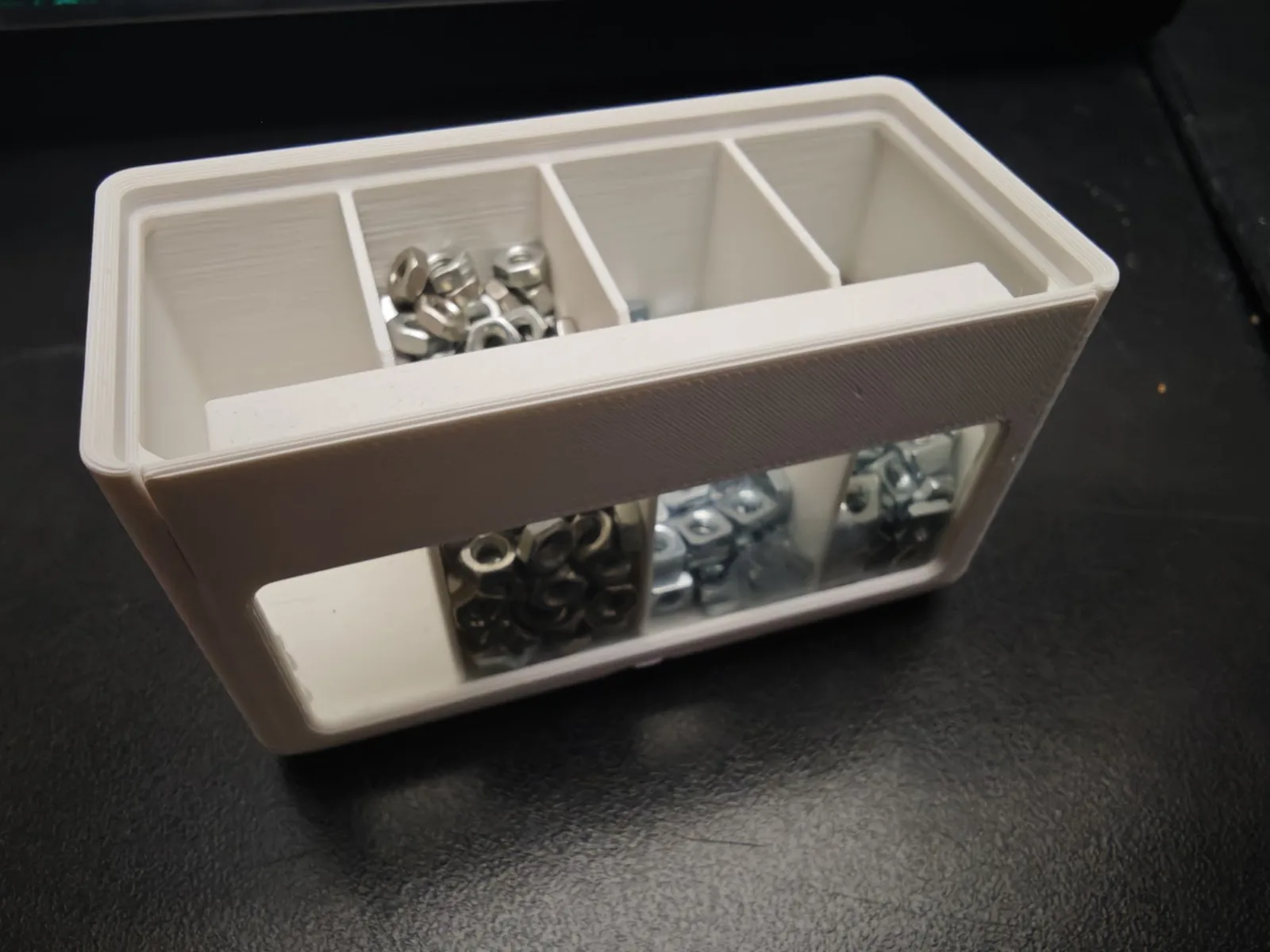
The configurator draws the same bin when “glass front” is ticked, with 1 to 5 compartments across a \(2 \times 1\) bin; more would leave the end compartments too narrow beside the corners that hold the slide. The slide’s size is an input, so a longer bin takes a pane cut to length, and the page checks that the bin is tall enough for the slide and that the slide fills the width with enough backing at its ends. Its 3MF and STL files hold the box standing and the front panel lying on its face in front of it, ready for the slicer; the STEP file holds the two parts assembled, with the slide in place. The original design, drawn in Fusion with two compartments, is available as a STEP file.
The Gridfinity project
Zack Freedman introduced Gridfinity in April 2022 on his channel Voidstar Lab (Figure 10.7.2). He had set out to tidy his own workshop and ended up redesigning how it is tidied: in Fusion 360 he drew nearly a hundred storage blocks and baseplates for the drawers, the tool chest, the workbench and the frames of his printers. The aim was not to store as much as possible in a given volume but to finish projects. Every item gets a home within reach of where it is used, lies open so that one hand can take it, and goes back in seconds. That is why the bins have no lids, why the scoop lets a finger sweep small parts out, and why the label tab is undercut so that it also serves as a handle for carrying a bin to the bench.
The baseplate is the least that is needed to organise the organisers. Its socket lets a block drop in with no resistance, and the short vertical band keeps it from being knocked out; where that is not enough, four magnets per socket add holding force. Every block stays inside its own cells and every height is a multiple of \(7\) mm, so any set of blocks fits together and a low block can be stacked to the height of a tall neighbour. The fixed grid also makes new blocks cheap to design: a template is scaled to the number of cells and the holder for one particular tool is added to it.
Freedman released the system as free, open-source hardware and called it a framework for the community to extend, not a finished product, crediting Alexandre Chappel’s modular storage system as its inspiration. He asked that designs built on it be shared under the tag gridfinity, and the community has since added blocks for almost every tool and several generators, among them gridfinity-rebuilt-openscad and the Fusion add-in cited above. For a designer the lesson is in what was fixed: the grid, the height unit and one profile form the interface, and everything inside a cell is left free.