How to study mechanics
The lecture that felt best taught the least
Physics teachers at Harvard once ran an experiment on their own introductory mechanics students [1]. They split 149 students into two groups and taught two consecutive classes in week 12 of the semester, one on statics and one on fluids. Each group received one class as a polished lecture, with an experienced instructor solving the problems at the board, and the other class as active learning, where the students worked the same problems in small groups and the instructor gave the full solution afterwards. Slides, handouts and problems were identical. The only difference was whether the students were shown how to solve each problem or had to attempt it first.
After each class the students took a short test and answered a questionnaire about how much they felt they had learned. Figure 1 shows the result. The test scores were higher after the active class, by almost half a standard deviation. The questionnaire went the other way: the students rated the lecture as the class where they learned more, and most of those interviewed described the active class as disjointed and frustrating.
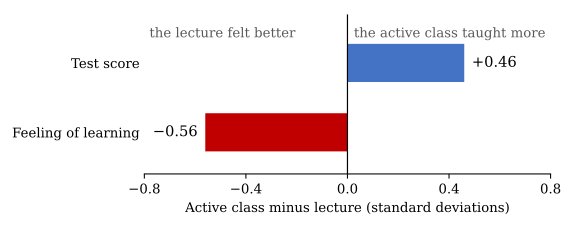
The authors explain the gap with fluency. A good lecturer makes every step look obvious, and following a smooth argument produces the same feeling as understanding it. Working the problem ourselves, with its false starts and confusion, feels like failing. Beginners are the worst judges of this. The feeling of learning tracked the test score only for students who arrived with a strong physics background.
An AI assistant offers the same shortcut. Shen and Tamkin gave 52 programmers, mostly junior, 35 minutes to build two features with a Python library none of them had used, half with an AI assistant and half by hand [2,3]. On a quiz afterwards, without help, the AI group scored 17 percent lower and was not significantly faster. The largest gap was in debugging: the hand-coding group met more errors and had to resolve each one, and that is where the skill formed. Participants who only asked the assistant conceptual questions and wrote and fixed the code themselves scored 65 percent or more, about the hand-coding average.
Watching a teacher solve a problem and watching a model write the code have this in common. Both deliver a correct result without the struggle that builds the skill, and both feel productive while they happen.
Studying is a set of techniques
Liljeqvist’s handbook Plugga smartare opens with a plain claim: study techniquesv. studieteknik is plural, a toolbox of techniques that each fit a task, and nobody needs all of them [4, pp. 21, 28]. Of the three factors he names for success in studies, talent, attitude and technique, technique matters most because it is the one we can develop deliberately, and the right attitude tends to follow once we know how to work [4, pp. 26–7].
Which technique fits depends on what we are trying to learn. Liljeqvist separates three kinds of knowledge, and a mechanics course asks for all three (Table 1).
| What we learn | Mechanics example | How it is learned and kept |
|---|---|---|
| Facts | the names of the support types, what \(\mu\) stands for, the unit of torque | test yourself on them at growing intervals |
| Understanding | why the friction force points the way it does, why a two-force member carries load along its line | explain it in your own words, and test the explanation on a new situation |
| Skill | drawing a free-body diagram, setting up and solving the equilibrium equations | practise on problems that are hard, but not too hard |
The common mistakes are mismatches. We memorise what should be understood, for instance a list of support reactions, or we settle for understanding what must be done by hand. Engineering students need the vocabulary and the abstract understanding, “but that is not enough”: they also need so much routine with the problem types that they can run long procedures without questioning every step [4, p. 35].
If study technique is a set of skills, it should be taught like one, inside the courses that need it. This book tries to do its part. The techniques below come back as instructions in later chapters, in the form of phrases such as “convince yourself that this holds” or “verify this on paper”, and we mean them literally.
Active and passive understanding
Liljeqvist builds his advice on the same distinction as the Harvard study. Active understanding is being able to carry out a solution yourself and explain why it looks the way it does. Passive understanding is the feeling we get when someone else explains well, and students fail exams because they mistake one for the other [4, pp. 68–9, 195–6]. He warns in particular about the teachers who explain best. A clear explanation makes the hard step look easy, and the students leave convinced they have learned it [4, pp. 80, 195].
The study techniques students use most are rereading and highlighting. A large review of ten common techniques rated those two as the least useful, and practice testing and spaced practice as the most useful [5]. Rereading produces fluency: the second reading of a chapter feels easier than the first, and that ease is easy to mistake for knowledge. It is also easier than active work, so the active work gets postponed, yet we can hear someone explain the same thing a hundred times without learning it [4, pp. 78–9].
Recreate the worked example
“What I cannot create, I do not understand.”
— Richard P. Feynman, written on his blackboard at Caltech, found there at his death in 1988
The tension in a belt or rope wrapped the angle \(\beta\) around a drum, on the point of slipping with friction coefficient \(\mu\), satisfies the capstan equation of the friction chapter,
\[ T_2 = T_1\,e^{\mu\beta}, \]
see 6.6.3. Reading the derivation takes about a minute. Each step looks reasonable, and at the end the exponential seems inevitable. Now close the book, take a blank sheet, and derive it.
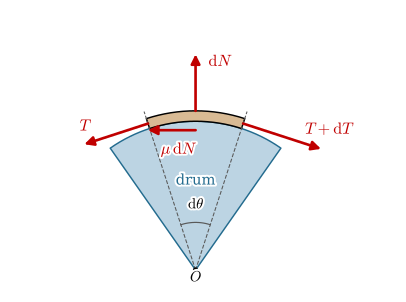
We cut out a short piece of belt spanning the angle \(\mathrm{d}\theta\), as in Figure 2. The radial balance with the small-angle approximation gives \(\mathrm{d}N = T\,\mathrm{d}\theta\), the tangential balance gives \(\mathrm{d}T = \mu\,\mathrm{d}N\), and integrating \(\mathrm{d}T/T = \mu\,\mathrm{d}\theta\) over the wrap gives the exponential. Most of us stall somewhere on the first attempt. Which way does the friction point? Why does the \(\mathrm{d}T\) term drop out of the radial balance? Where did \(\sin(\mathrm{d}\theta/2)\) go? Those stalls are where the learning happens, and the minute of reading skipped all of them.
Liljeqvist gives the same advice for every problem-solving subject: we do not understand a solution until we have redone it ourselves, by hand [4, p. 184]. His order of work is the craftsman’s, imitate first and experiment afterwards. We recreate the worked example step by step, then solve a problem that differs from it a little, and only then move on to harder ones [4, pp. 184–6]. He also removes the excuse of waiting until the derivation makes sense. Understanding cannot be produced by will. Listening, redoing a solution, reasoning about a step and trying to explain it are things we can decide to do, and understanding is what they leave behind [4, p. 197]. A student who refuses to write \(\mathrm{d}N = T\,\mathrm{d}\theta\) before seeing why the small-angle approximation is allowed has nothing to look at, and stays stuck [4, p. 186]. The student who writes it down, finishes the derivation and then sets \(\mu = 0\) to see whether \(T_2 = T_1\) comes out has a worked derivation in front of them to question, and the reason for the approximation usually becomes clear on the second or third pass. Children learn a language the same way, by using words long before they could say what the words mean.
The same applies to code. Running a cell that someone else wrote, or that an assistant generated, tells us that the code works. Writing it from an empty cell, getting the error message and finding out why tells us how it works. This book asks for the paper derivation first and the SymPy code second for that reason. The computer handles the algebra well, but the free-body diagram, the choice of what to neglect and the check that the number of equations matches the number of unknowns only form in the head of the person who does them.
Test yourself, and come back
Without repetition we forget quickly. Ebbinghaus measured in the 1880s how much of a learned list was gone after hours and days, and his forgetting curve has since been replicated with his own method [6]. Each repetition flattens the curve, and the repetition works best as retrieval: close the book, reproduce, then check.
Liljeqvist’s schedule starts with the ten-minute rule. Ten minutes after a study session, test yourself on what you just learned, “not in an hour, but now”, and it stays until the next day. Test again the next day and it stays for a week. Later repetitions follow after a month and after half a year, each gap two to four times the one before [4, pp. 59, 84–8]. If about nine answers in ten come back right when we test, the gap is about right [4, p. 94]. Figure 3 shows the pattern in a simple model.
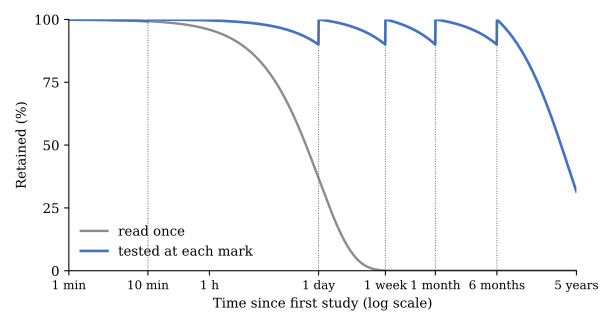
Research supports growing intervals. In a study with more than 1,350 participants, the best gap before a review grew with how long the material had to be kept, from about two days for a test one week later to three to five weeks for a test a year later [7].
For a mechanics course the translation is direct. When a teacher works a problem at the board, recreate the solution yourself before the day is over [4, p. 195]. After reading a section, close it and reproduce the main derivation on paper, then do it again from memory ten minutes later, the next day and the next week. Redo a worked example without looking at the solution, and open the solution only when stuck for real. Come back to last week’s free-body diagrams before starting this week’s. When something in the book reads as obvious, take that as a reason to test it.
Solve problems like a craftsman
Most problems in a mechanics course are variants of a few typical ones. A crate on a ramp and a car parked on a hill have the same free-body diagram, and recognising that is half the solution. Liljeqvist calls the store of solved problems an experience bank: a fast problem solver is someone who has done the same kind of problem many times before [4, pp. 186–9]. Practise at the level where the problems can be solved with a little effort. If we are stuck all the time, we have gone too fast and should step back to simpler examples [4, p. 193].
When no known solution fits, Polya’s four steps, as Liljeqvist retells them, translate directly into mechanics [4, pp. 200–2]. We understand the problem by stating what is sought and drawing the free-body diagram. We make a plan by choosing the principle, equilibrium, Newton’s second law, energy or momentum, and by counting the unknowns against the equations. We carry out the plan. Then we check the result.
The check most worth learning is the extreme case. Set \(\mu = 0\) in the capstan equation and \(T_2 = T_1\), as it must be for a frictionless drum. Set \(\beta = 0\) and the same holds, since there is no contact. Double the wrap and the ratio is squared, which is why a sailor takes one more turn around the winch and not a firmer grip. A result that fails an extreme case is wrong, however tidy the algebra looked.
Liljeqvist adds a discipline he calls thinking slowly [4, p. 204]. When a problem does not open at once, we are tempted to jump at anything that resembles a solution. Studying mechanics is also practice in not guessing: in saying “I cannot solve this now, but I may be able to solve a piece of it” [4, p. 205].
The old-exam trap
The most common way to prepare for a written exam is to work through old exams until every problem type is recognised on sight. It feels efficient, and with a traditional exam of five or so problems it often works. Bergqvist went through 16 final exams from introductory calculus courses at four Swedish universities and found that 15 of them could be passed by recalling facts and copying familiar solution steps alone [8]. What this kind of preparation builds is recognition, the same fluency the polished lecture gave the Harvard students. It shows when a familiar problem arrives in unfamiliar words: the mechanics is the same as last year, the method no longer fires, and the question afterwards is why the exam was this hard.
Course evaluations say it every year: this year’s exam was harder than the practice exams. The problems are drawn from the same chapters with the same kinds of model, and each year’s class is about as able as the last, so the exams cannot all be getting harder. Every practice exam is last year’s exam, the one that students then called the hardest.
What differs is how we work through them. A practice exam is usually worked with the solutions at hand, a peek when stuck, and no clock, often more than once. By the end every problem looks easy, because each has been seen solved, and a problem with a known solution always looks easier than it was. The real exam is the first time we meet a set of problems with no solution to look at. It measures whether we can solve a new problem, and the practice exam, used this way, only measured whether we could follow a solved one.
A practice exam can still be a test, but only once. Take it closed-book and timed, without opening the solutions until the time is up, and mark it honestly. Whatever went wrong then is the list of things to practise.
Mixed practice has been tested as the remedy in a classroom. When the review problems in a mathematics course were drawn from several chapters, so that the chapter heading no longer told the students which method to use, they scored far higher on a test a month later than students who practised each method in its own block [4, p. 255,9]. Choosing the method is part of the skill, and blocked practice does that step for us. Mix the end-of-chapter problems from different chapters, and before solving each one, decide whether it calls for equilibrium, Newton’s second law, energy or momentum.
In one of our own mechanics courses a problem needed the integral of \(x^3\), and the class could not solve it. We learned afterwards that every example in their calculus course had been an integral of \(x^2\), practised until the answer was known by heart, and that none of them had seen how to integrate \(x^n\). These students had passed calculus. They knew one answer, and the rule behind it,
\[ \int x^n\,\mathrm{d}x = \frac{x^{n+1}}{n+1} + C, \qquad n \neq -1, \]
had never been part of what they practised. An exam built from the same \(x^2\) examples could not tell knowing the answer from knowing the rule.
When it feels worse
Active work will feel slower and more confusing than a good lecture, especially in the first weeks, and without the evidence it is reasonable to conclude that it teaches less. The Harvard measurements say the opposite. Liljeqvist goes further and advises students to look for confusion, since deeper insight is usually preceded by it [4, p. 67]. He also observes that students who found school mathematics easy are often the ones caught out at university, where the pace rises and talent alone stops being enough [4, pp. 187, 248].